


Reporting Issues & Grievances
More Info on Reporting
All members of Lebanon Valley College have the right to work, study, and live in a campus environment free of sex discrimination. Lebanon Valley College prohibits discrimination against its employees and students on the basis of sex, and will not tolerate sex discrimination, whether in the form of sexual harassment, sexual assault, dating violence, domestic violence, stalking, or any other form of sexual misconduct. Sex discrimination is contrary to the values of Lebanon Valley College and may constitute a violation of the College’s Title IX Policy, Student Conduct Code, and/or policies applicable to faculty and staff.
- Read the LVC Title IX Sexual Harassment Policy (.docx).
- Learn more about LVC’s response to sex discrimination.
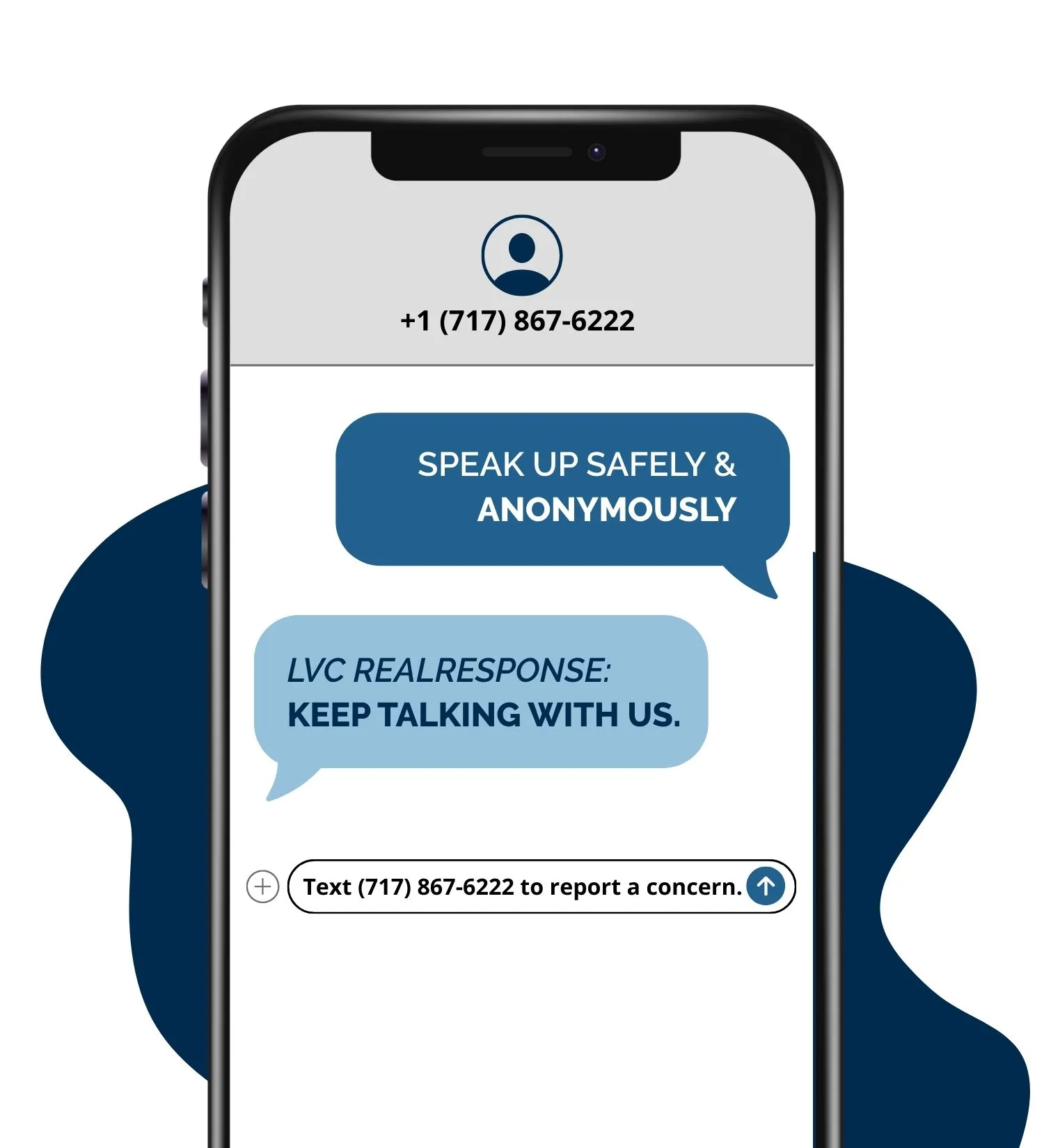
Easy and anonymous reporting: Text: 717-867-6222, Email: report@lvc.realresponse.com
Hazing is defined as any action or situation that recklessly or intentionally endangers the mental or physical health or safety of a student, or which willfully destroys or removes public or private property for the purpose of initiation or admission into an organization recognized by an institution of higher education.
Report hazing via RealResponse or use this online form.
The Lebanon Valley College Student Code of Conduct defines the expectations of community membership that students and recognized student organizations are held accountable to and outlines the process and procedures the College will use when responding to alleged violations of these expectations, also called Community Standards. Community Standards prohibit activities related to drug and alcohol use; harassing, harming, and disruptive conduct; safety; failure to comply; and theft, misuse, and damages.
Report violations via Real Response or use this online incident report form.
A bias incident is an act of bigotry, harassment, or intimidation committed by or against a member of the Lebanon Valley College community based on actual or perceived race, color, sex, religion, ancestry, genetic information, national origin, sexual orientation, gender identity or expression, familial status, marital status, age, veteran status, mental or physical disability, use of guide or support animals and/or mechanical aids, or any other basis protected by applicable federal, state, or local laws. These acts may include, but are not limited to, slurs, graffiti, written messages, or images that harass or intimidate individuals or groups because of their membership in the above-listed protected classes.
Report bias using RealResponse. Text: 717-867-6222, Email: report@lvc.realresponse.com
To report an alleged crime on the Lebanon Valley College campus, call Lebanon Valley College campus safety at ext. 6111 or from outside the college phone system, 717-867-6111. The same numbers are used to report a non-emergency security or campus safety related matter. Officers are available at these respective telephone numbers 24 hours a day, 365 days per year.
For emergencies, dial 911.
Report crime using RealResponse. Text: 717-867-6222, Email: report@lvc.realresponse.com
Academic and Accessibility Grievances
A student may file a grievance against a faculty member if the student has sufficient reason to dispute a final grade earned in a course.
A student may file a grievance against a faculty member unrelated to grades or Title IX (sexual harassment and discrimination) violations. Such grievances typically address violations of the College’s, department’s, or program’s standards regarding professional conduct, safety, and fairness.
Students with disabilities who believe they have been denied rightful and reasonable accommodations may file a formal grievance.
If a resolution cannot be reached after the College’s Accessibility Grievance Procedures or Reporting Issues & Grievances are completed:
Students residing in Pennsylvania: In the unlikely event that an issue cannot be resolved through the institutional complaint process, students who reside in Pennsylvania should contact the Pennsylvania Department of Education and follow its Pennsylvania SARA Student Complaint Process. The process aligns with the State Authorization Reciprocity Agreement (SARA). The Pennsylvania Department of Education is the agency responsible for oversight in resolving complaints.
“Students residing outside Pennsylvania: SARA consumer protection provisions require the institution’s home state, through its SARA State Portal Entry, to investigate and resolve allegations of dishonest or fraudulent activity by the state’s SARA-participating institutions, including provision of false or misleading information.
“The student should begin the complaint process with the institution and if resolution is not found, the student would contact the institutions’ home state SARA Portal Entity [links above]. NC-SARA maintains a directory of State Portal Entity (SPE) Contacts and SARA Student Complaint Process Information by State.” (NC-SARA website)
Unresolved complaints may be filed with the Middle States Commission on Higher Education, the College’s regional accrediting agency, once all other avenues provided by the College and the State agency or SARA have been exhausted. The link below provides information on the Commission’s complaint policies and procedures.
Filing Complaints
Lebanon Valley College is accredited by the Middle States Commission on Higher Education (MSCHE). MSCHE provides opportunities for students, faculty, staff, and members of the public to submit a number of different types of complaints:
- Complaints Involving Applicant or Member Institutions
- Third-Party Comments for Institutions Under Review
- Whistleblower Complaints (involving wrongful conduct of Commission representatives while in their service to the Commission)
- Complaints Against the Commission (involving the Commission’s compliance with its own policies and procedures or requirements for federal recognition).
Information about the complaint process may be found at the following link: www.msche.org.
Complaints about the College, including those considered misrepresentation, may also be filed with the Pennsylvania Department of Education.
Complete the Issues & Resolution form to report issues that fall outside of the categories above.
Student Complaints Statement
Students who have grievances with actions, decisions, and/or processes at the College are entitled to register those complaints formally and have their complaints deliberated upon and resolved by appropriate College officials. Formally made complaints that are addressed to an institutional officer with the responsibility to handle the complaint will be tracked. Information pertaining to student complaints includes date complaint received, student name and LVC ID, nature of the complaint, summary of action taken by the recipient, resolution or outcome, and notations of any subsequent changes to College policy or procedure as a result of the complaint. Information about student complaints will be available to regulatory bodies and accrediting agencies, including the Middle States Commission on Higher Education. Note that some grievance processes at the College have an option for informal resolution that may not be tracked.