



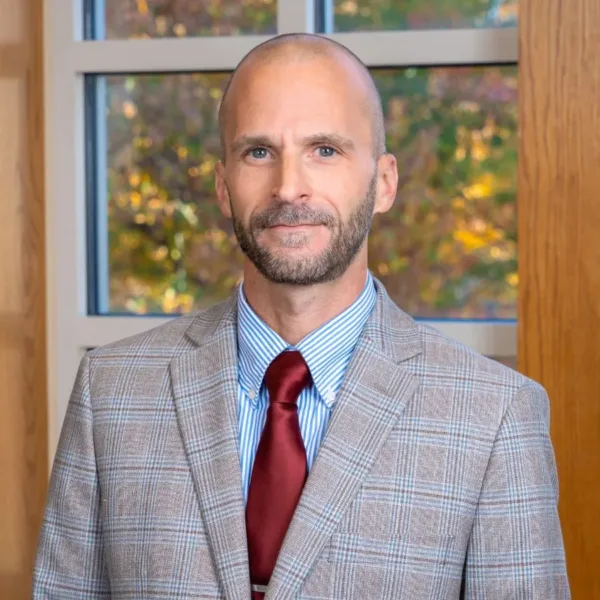
Michael Kitchens
Professor of Psychology
Email: kitchens@lvc.edu
Phone: 717-867-6197
Office Location: Clyde A. Lynch 287-G
Website: https://www.researchgate.net/profile/Michael-Kitchens-4?ev=hdr_xprf
Dr. Michael Kitchens is Professor of Psychology at Lebanon Valley College. He received his Ph.D. in Experimental Psychology from the University of Mississippi. He conducts research in the areas of the self, the psychology of religion and spirituality, and existential psychology. His main focus is on understanding the connection that religious and spiritual beliefs, practices, and values have with the ways people think about themselves (e.g., self-concept, self-esteem). He has published research in peer-reviewed journals, like Self & Identity, Journal of Social Psychology, Psychology of Religion & Spirituality, and The International Journal for Psychology of Religion, and he has presented his research at national and regional conferences.
REPRESENTATIVE PUBLICATIONS
Kitchens, M., Philips III, Russell E., Bartal ’25, M’27, Sweigart ’26, J. (2026). “The Psychological Experience of the Self in Self-focused (Versus) God-focused Spirituality,” Mental Health, Religion, and Culture.
Kitchens, M. B., & Meier, B. P. (in press). The fearful mind of artificial intelligence: Fear and perceived existential threat of artificial intelligence as a function of its cognitive and emotional capabilities. Journal of Social Psychology https://doi.org/10.1080/00224545.2025.2503006
Kitchens, M. B., Phillips, R. E., Lang, I. M., Seguinot-Velazquez , Y., Stum, J. P., & Petrasic, S. E. (2024). Ideological identity: Worldviews and values are self-defining. Self & Identity, 23(7-8), 634-655 https://doi.org/10.1080/15298868.2024.2423831
Kitchens, M. B., Lang, I. M., Petrasic, S. E., Remper, B. C., & Wilson, B. M. (2020/2022). Cognitively accessible words associated with God as effective lexical primes. Journal for the Cognitive Science of Religion, 8(2), 78-101. https://doi.org/10.1558/jcsr.22679
Kitchens, M. B., Kitchens, J. M., Kline, J., & Longenecker, E. (2022). The explanatory power hypothesis: On Christians’ identification with and perceived value of science. Journal of Psychology and Christianity,40(4), 280-297
Meier, B. P., Kitchens, M. B., Kupersmith, D. E., Houck, K. E., Keyton, N. S., Petrasic, S. E., Schultz, E. H., Sheriff, S. S., Simmers, M. M., Underwood, J. O., Walker, S., & Zweizig, D. N. (2021). Be responsible? Priming “responsibility” and the bystander effect in a field setting. Experimental Psychology, 68(2), 107-112. https://doi.org/10.1027/1618-3169/a000513
Kitchens, M.B., & Phillips III, R. E. (2021). The curvilinear relationship between beliefs about God and self-concept clarity. Psychology of Religion & Spirituality, 13(1), 26-35. https://doi.org/10.1037/rel0000181
Buzinski, S. G., & Kitchens, M. B. (2017). Self-regulation and social pressure reduce prejudiced responding and increase motivation to be non-prejudiced. The Journal of Social Psychology, 157(5), 629-644. https://doi.org/10.1080/00224545.2016.1263595
Phillips III, R. E., & Kitchens, M. B. (2016). Augustine or Philistine? College students’ sanctification of learning and its implications. The International Journal for the Psychology of Religion, 26, 80-94.https://doi.org/10.1080/10508619.2014.999492
Kitchens, M. B. (2015). Thinking about God causes internal reflection in believers and unbelievers of God. Self & Identity, 14(6),724-747. https://doi.org/10.1080/15298868.2015.1072108
Kitchens, M. B. (2014). Word clouds: An informal assessment of student learning. College Teaching, 62(3), 113-114. https://doi.org/10.1080/87567555.2013.807216
Kitchens, M. B., Mitchell, M. E., Collins, A. E., Horna, M. A., Rine, T. M., & Tran, A. N. (2011) Individual differences in a preference for positively- and negatively-oriented Christian information. Journal of Psychology and Christianity, 30(1), 16-27.
- Introduction to Psychological Thinking
- General Psychology
- Research Methods in Psychology
- Social Psychology
- Science of Emotion