

Campus Initiatives
Leave the Leaves
Student and faculty initiative to collect fall leaves on campus for use by overwintering insects, including bees, and spring composting.
Renewable Energy & Solar
Since 2012, LVC has committed to offsetting all Scope 2 emissions (emissions from purchased electricity) by purchasing RECs (Renewable Energy Certificates) as part of their contracts to purchase power. This means 100% of LVC’s electricity usage derives from renewable energy.
Community EV Charging stations are now live and are located on campus, including near Mund.
LVC Solar Farm (expected completion date: 2027) is projected to generate nearly 60% of LVC’s electrical energy needs and yield a significant financial return on investment. The planned installation will be located in North Annville Township on a portion of the 87-acre plot of farmland owned by the college and leased to two local farmers. The new on-site solar installation will allow the college to work toward transitioning its remaining energy needs from natural gas to solar in the future years.
Tree Campus Higher Education
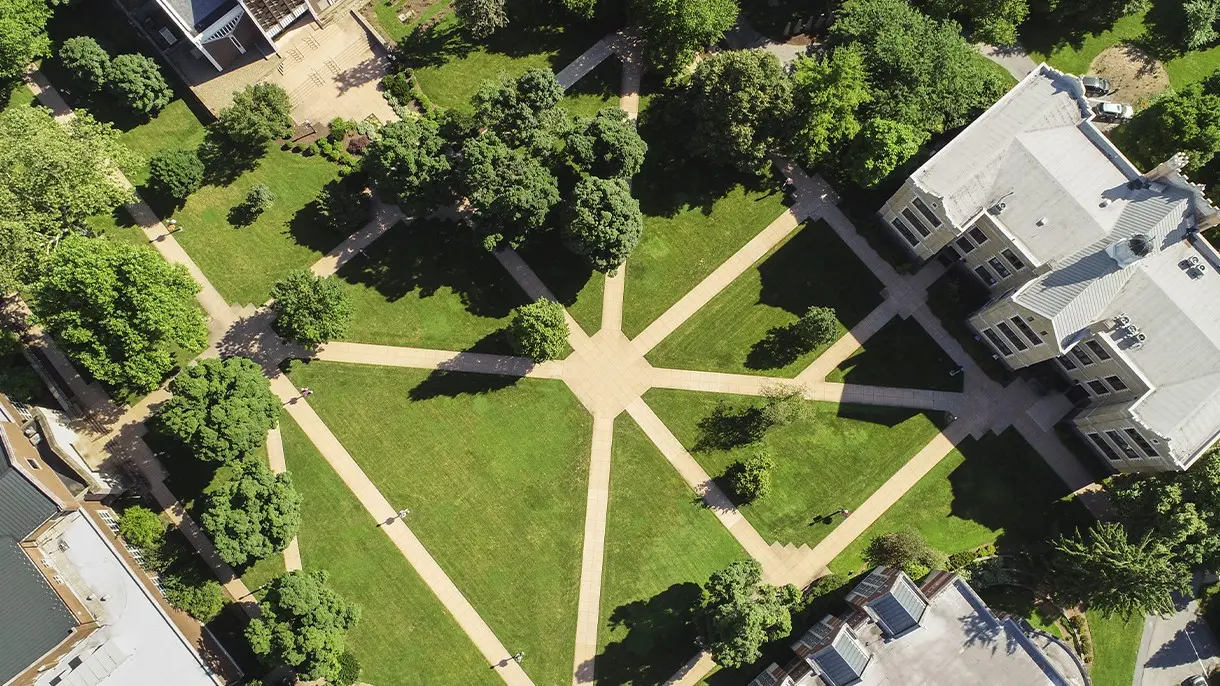
Tree Campus Higher Education is a nationwide network of colleges committed to effective and sustainable tree stewardship. On college campuses, trees connect buildings, cool walkways, and form the basis for a grounded college experience. Beyond beauty, trees make campuses more healthy and resilient places to live and learn. Lebanon Valley College features 357 acres and an abundance of trees, including over 87 species (interactive tree map) and its own Wood Thrush Research Preserve. This 20-acre oak hickory forest has served as a living laboratory for over 500 students across eight different courses and the location for 15 different research projects. As of Spring 2025, LVC has begun its partnership with Tree Campus Higher Education, and expects to earn its Tree Campus certification by Fall 2025. Certification entails
- Campus Tree Advisory Committee (student, faculty, staff, and community representation) that assists in providing guidance for future planning, approval of a comprehensive campus tree plan, education of the campus population as to the benefits of the campus trees, and development of connectivity to the community
- Campus Tree Care Plan
- Campus Tree Program with Dedicated Annual Expenditures
- Arbor Day Observance
- Service-Learning Projects
Bee Campus USA
Thinking globally and acting locally, Bee Campus USA provides a framework for university and college campus communities to work together to conserve native pollinators by increasing the abundance of native plants, providing nest sites, and reducing the use of pesticides.
As of Spring 2025, LVC has begun its partnership with Bee Campus USA, and expects to earn its Bee Campus USA certification by Fall 2026!
Bee Campus USA affiliates make commitments to conserve native pollinators. Students, faculty, administrators, and staff work together to carry out these commitments and make their campus a better place for pollinators. Commitments include:
- Establishing a Bee Campus USA committee to advocate for pollinators: Our Bee Campus USA committee is comprised of Ashley McFalls (Chair, Associate Professor of Neuroscience), Alexis Baker (Executive Director of Facilities Management) and Jennifer Thornsberry (Biology Laboratory Technician)
- Creating and enhancing pollinator habitat through native plants and nesting sites: The biology, plant and environmental clubs, in conjunction with Dr. Rebecca Urban and the students in BIO302 Plant Diversity have been working to establish a native pollinator garden outside of Neidig Garber. LVC grown native plants were planted in the pollinator garden in April 2025! LVC is also committed to establishing more native plants for pollinators across the campus
- Reducing the use of pesticides: The key to managing harmful pests is preventing pests from establishing in the first place and LVC excels at this! This focus on preventative strategies means that LVC only uses pesticides where necessary. We aim to further reduce pesticide use in the future by employing effective alternatives to pesticides. You can read about our Integrated Pest Management strategy here: IPM strategy
- Incorporating native pollinator conservation into the curriculum: It is up to all of us to spread the word about the importance of our native pollinators. LVC Faculty from diverse disciplines such as biology, psychology, neuroscience and the humanities have begun to incorporate this into their curriculum. Additionally, our Bee Campus USA certification allows us to talk about pollinator conservation on campus tours!
Apparel Waste Initiative
Coming soon!
Rain Barrels
Green LVC expects to install campus rain barrels throughout the 2026 academic year. These rain barrels will be used, primarily, to help irrigate LVC’s landscape and our faculty-student ecotherapy wellness garden (coming soon).
Ethnobotanical Wellness Garden
Spring 2025, Dr. Machado and student Kati Shanaman developed LVC’s Ethnobotanical Wellness Garden, which establishes sites for increased awareness and interaction with the natural world as part of the ever-growing fields of ecotherapy and mindfulness—used by folks as diverse as Military Special Forces, Buddhist priests, children, and adults alike. This garden consists of native plant species used by the Susquehannock Tribal Nation, on whose historic homelands LVC sits. Botanical signs provide pathways for learning more about native fauna and flora of the area, how the Susquehannock used native species, and how native species-initiatives at LVC work to benefit the broader ecosystem. Project inauguration: Spring 2026.
Dining Services
Eating well and living well go hand-in-hand. That’s why Metz pledges to do its part to be good stewards of the earth’s natural resources. Metz sustainable efforts meet customers’ needs today while protecting our environment for future generations. Metz is committed to working closely with partners at LVC and vendors in executing environmentally responsible initiatives and programs.
Metz now offers biodegradable dishes and cutlery as part of its catering service and has been acquiring sets of China with the goal of offering a fully no-waste option for events.
Food Waste Partnership (Weigh the Waste) | Race to Zero
The Environmental Sustainability Advisory Committee (ESAC) partners with Metz to collect data on food waste in the college dining hall. From this data, the committee creates meaningful and accessible statistics to inform students of how much food and money is wasted each semester. The goal of these studies is not only to inform students of how much is being food is being wasted, but also to encourage more sustainable eating habits.
My Green Lab ®
MyGreenLab.org focuses on sustainability in the laboratory, since labs are often very wasteful. They offer a program with six modules that focus on different problem areas like waste, energy, water, etc. LVC’s Jennifer Thornsberry, Biology Lab Technician, is directing LVC’s involvement in this initiative. LVC is part of My Green Lab’s “freezer challenge” to help promote the use of best storage practices for frozen samples. In this program, labs can compete with other labs/institutions to see who can save the most energy.
Sustainability House
The Sustainability House is an on-campus special interest housing opportunity that gives students the chance to live in a community where they may learn about how to live in a sustainable way. They will be asked to adopt various practices while living in the house, such as reducing energy and water use, and recycling. The students will also host programs and develop initiatives to educate students, faculty, and community members. Current project proposals include hydroponics, native plant gardens, and monitoring of the house’s water and electricity usage.
Climate Action Plan
An initiative to develop a Climate Action Plan for LVC began fall 2017, in response to President Thayne signing the American College and University Presidents’ Climate Commitment (ACUPCC) on behalf of Lebanon Valley College. A Climate Action Plan (CAP) subcommittee of the ESAC was formed and charged with developing the plan. After a year of work, the CAP Committee developed a final draft of the plan, which was endorsed by the faculty and student government. The plan, while helpful, did not provide a well-defined approach to addressing near term opportunities to reduce Scope I and II emissions. Recognizing that a major portion of the College’s carbon footprint results from campus energy use, a Campus Energy Master Plan was written in 2020 and updated in 2023. The recommendations in this plan have been followed, resulting in 23% reduction in energy consumption on campus. The plan also established the need for on-site renewable energy generation. Plans were developed to build a solar installation that would provide 58% of the campus electric energy demand.
While the initial CAP was drafted but not fully adopted, the Campus Energy Master Plan has driven carbon reduction efforts. The next step in climate action planning is to revisit the Climate Action Plan from a holistic view so that the plan moves beyond carbon emissions to include water conservation, chemical and pesticide use, carbon sequestration, supply chain analysis, waste disposal and recycling, and environmental justice.
E.A.T. Initiative
E.A.T. (Engage, Analyze, Transform) was a student-centered research group sponsored by the President’s Innovation Fund. The interdisciplinary research undertaken by E.A.T. had two goals: to improve the dining experience for students and to dissolve the boundaries between the dining and academic spaces on campus. Specifically, E.A.T. used data-driven research to assess and promote the goals of ethical reasoning, understanding of diversity, and environmental stewardship.
Sustainability was one of the core objectives and was central to two of projects:
- “Experience More, Waste Less” (“Weigh the Waste”) began in fall semester 2013 as the E.A.T. Research Group project designed and implemented by Ashley Smith ’15. On 8 separate occasions during a given semester (usually a Wednesday night), student groups volunteered to intercept students’ plates before they were sent to the dish room. Students separated edible from inedible waste and then weighed the separated items at the end of the night. There were 12 continuous semesters of data on food wasted in the dining hall.
- There were two studies conducted to gauge the ways that students react to messaging that encourages them to be mindful of their food waste. Both studies demonstrated that students do notice signage and that the signs have some effect on their behavior. MCURC Food Waste Messaging Seed Study was conducted in spring 2018. LVC collaborated with four other universities (USC, UCSB, UC Davis and Stanford) to measure the impact of Food Waste messaging. Various messages were placed around the dining hall at the beginning of a week; later that week, students were surveyed to see if the signs were noticed.